The Importance of Trained and Licensed Security Officers

Licensed security officers providing professional protection at a commercial property.

When you hire someone to protect your employees, customers, property, and assets, a uniform alone is not enough. The person wearing it needs the knowledge and preparation to respond professionally when something goes wrong. That is why licensed security officers are an important part of a dependable security program.

Licensing establishes basic qualifications. However, effective security also requires practical training, good judgment, communication skills, and ongoing supervision.

For business owners and property managers, understanding the difference between simply placing someone on-site and using qualified security professionals can help you make a better decision. In this article, we will look at why licensing matters, how security training improves performance, and how All Pro Security builds accountability into its guard services.

Why Licensed Security Officers Matter

Security officers regularly work in situations where good judgment matters. They may control access to a building, address suspicious activity, respond to an alarm, document an incident, or help manage a confrontation. Licensing creates a baseline for who can perform that work.

The U.S. Bureau of Labor Statistics security guard career guide notes that most states require security guards to be licensed or registered. Armed officers generally face additional requirements because of the responsibilities involved with carrying a firearm. Utah also establishes specific requirements for private security officers. According to Utah’s Division of Professional Licensing, applicants for an unarmed private security officer license must complete approved basic training and meet background-check requirements.

For a client, those standards provide an important layer of confidence. A professional security company should understand the laws in every state where it operates and make sure officers meet the appropriate requirements. All Pro Security maintains licensed operations across several western states and provides a range of professional security services through All Pro Security for businesses with different protection needs.

Security Training Goes Beyond Getting a License

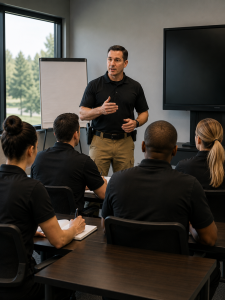
Security instructor providing professional training to security officers in a classroom setting.A license should be viewed as the starting point rather than the finish line. Effective security training prepares an officer for the situations they may actually face while working a post. That includes learning how to observe suspicious behavior, communicate clearly, follow post orders, write useful reports, and respond appropriately during emergencies. Communication is especially important. An officer may need to speak with employees, customers, contractors, first responders, or someone who is upset or confrontational.

Data from the Bureau of Labor Statistics Occupational Requirements Survey for security guards shows how important communication, decision-making, interaction with others, and on-the-job preparation are within the profession. Those responsibilities highlight an important point. Security work depends on people skills as much as physical presence. Good officers need to know when to intervene, when to observe, when to call for assistance, and how to communicate what happened afterward.

Officer Certification and Ongoing Development Build Better Guards

Licensing requirements establish minimum standards, but professional development should continue after an officer receives a license. Depending on the assignment and state, additional officer certification or specialized training may cover firearms, de-escalation, report writing, access control, emergency procedures, patrol techniques, or other skills.

All Pro Security provides armed and unarmed security officer training courses through its Utah operation. These courses help prospective officers complete required training while developing the knowledge needed to begin working professionally. The company’s unarmed security guard licensing course, for example, includes the training and examination required before students can submit their documentation when applying for a Utah unarmed security guard license.

Ongoing development also helps officers adapt to different environments. A security officer working a construction site may focus on gate control, equipment protection, and after-hours activity. An officer assigned to a corporate office may spend more time managing visitors and controlling access. Retail security may require stronger customer-service and de-escalation skills. The assignment changes, so preparation should change with it.

Businesses should ask potential security providers how officers are trained for specific posts instead of assuming every guard receives the same preparation.

Training Works Best When It Is Backed by Accountability

Even excellent training loses value without supervision and accountability. A strong security program should give officers clear post orders and defined responsibilities. Supervisors should also have a way to verify that required patrols and checks actually happen. This is one area where technology can support licensed security officers.

All Pro Security combines professional personnel with reporting tools, supervisory oversight, and technology designed to provide clients with greater visibility into their security program. For example, a property manager should not have to wonder whether an overnight patrol checked a rear entrance. Patrol verification can create a record of that activity.

Businesses that do not need a full-time officer at one location may also benefit from All Pro Security mobile patrol services. Mobile patrol officers can conduct scheduled or randomized property checks, respond to incidents, and provide detailed reporting after patrols. Likewise, incident reports help managers identify repeating problems. Several reports involving the same gate, parking area, or unauthorized visitor may reveal an issue that deserves additional attention. Training teaches an officer what to do. Accountability helps confirm that the work gets done.

Choosing a Security Company With Qualified Officers

When comparing security providers, price matters, but it should not be the only consideration. Ask how the company recruits officers. Find out how it verifies licensing requirements. Ask what security training officers receive before arriving at your property and what ongoing instruction is available afterward.
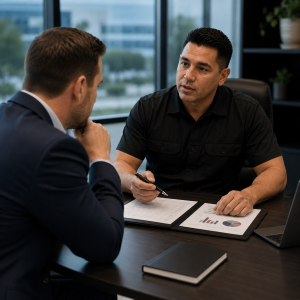
Security professional meeting with a business owner to discuss choosing qualified security officers and services.

You should also ask:


  • Are officers properly licensed for the work they perform? 
  • How are background checks handled?
  • What additional officer certification or specialized training is available?
  • How are officers trained for individual client sites?
  • Who supervises the officers?
  • How are patrols documented?
  • How are incidents reported to clients?
  • What happens when coverage or site conditions change?


The answers can tell you much more than an hourly rate. All Pro Security’s security services include professional security guards, mobile patrol, integrated security systems, event staffing, emergency response, executive protection, fire watch, and other solutions. That range allows businesses to build security around their actual risks rather than relying on a one-size-fits-all approach.

Put Qualified Security Professionals on Your Property

The effectiveness of a security program often comes down to the people responsible for carrying it out.

Licensed security officers bring a foundation of qualification and accountability. Strong training builds on that foundation with better observation, communication, decision-making, and response skills. Supervision and technology can then help make sure those standards continue after an officer arrives on-site.

All Pro Security works with businesses, property managers, government organizations, construction sites, retailers, residential communities, and other clients that need dependable security coverage.

Whether you need armed or unarmed guards, mobile patrols, emergency coverage, or an integrated security plan, our team can help determine the right approach for your property.

Contact All Pro Security today for a free consultation. Call 801-796-1227 or visit the All Pro Security website to request a customized security solution.

Picture of Kyle Haub

Kyle Haub

Author
Security and Support Specialist

All Pro Security
Privacy Overview

This website uses cookies so that we can provide you with the best user experience possible. Cookie information is stored in your browser and performs functions such as recognising you when you return to our website and helping our team to understand which sections of the website you find most interesting and useful.