What happens when a security officer misses a checkpoint, arrives late to a vulnerable area, or completes a patrol without anyone knowing whether the full route was covered? Paper logs may record activity, but they often cannot verify where or when that activity occurred. Security patrol tracking gives property managers and supervisors a clearer view of officer movements and completed duties. When paired with geo-fencing technology, it can confirm patrol coverage, improve communication, and create accurate records for review. In this guide, you will learn how these tools strengthen site protection, improve reporting, support officer accountability, and help All Pro Security deliver responsive services tailored to each property.
Security Patrol Tracking Creates Better Visibility
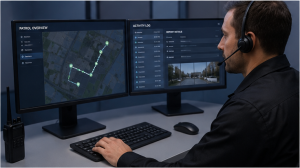
Effective security depends on knowing what is happening across a property—not simply assuming assigned tasks were completed. Security patrol tracking uses location-based technology and digital reporting tools to document routes, checkpoint visits, incident responses, and assigned activities.
Supervisors can review this information to confirm that officers are covering the areas identified in the site security plan. This visibility is especially useful on large or complex properties.
Warehouses, construction sites, apartment communities, office parks, and shopping centers may include several buildings, entrances, parking areas, loading zones, and perimeter points. A handwritten report may state that an officer patrolled the property, but it may not show which areas received attention.
Digital records make patrol activity easier to verify. Supervisors can identify missed checkpoints, unusual gaps, repeated problem areas, or routes that may need adjustment. The goal is not to monitor every movement unnecessarily. The goal is to ensure that each patrol supports the client’s security priorities.
All Pro Security can use this information to align officer activity with the needs of a specific location. That may include checking doors after closing, monitoring parking areas, inspecting equipment zones, or increasing patrol frequency near a recent concern.
Geo-Fencing Security Helps Verify Patrol Coverage
A geo-fence is a virtual boundary placed around a physical location or designated area. When an authorized device enters or exits that boundary, the system can record the activity.
Geo-fencing commonly relies on location data from technologies such as the Global Positioning System, which provides positioning, navigation, and timing information. In a security setting, geo-fencing security can help verify that an officer reached an assigned property or entered a required patrol zone.
This technology is useful when a security provider serves several locations or when one property contains separate patrol areas. Virtual boundaries can be established around entrances, parking lots, buildings, yards, loading docks, or other high-priority zones.
The tracking system can then document whether those locations received coverage during the scheduled patrol window. This gives supervisors a more complete picture than a paper log alone.
Geo-fencing security can also support faster follow-up. If an officer leaves an assigned area unexpectedly, misses a zone, or changes the planned route, supervisors can review the information and make contact.
A route change does not always indicate a problem. The officer may be responding to an alarm, medical incident, safety hazard, suspicious activity, or request for assistance. Tracking information helps supervisors understand what happened and document the reason for the change.
For clients, this provides another layer of verification. Instead of relying only on a final written report, property managers receive clearer evidence that assigned locations were visited.
Digital Records Strengthen Officer Accountability
Accountability works best when expectations are clear, performance is documented, and supervisors respond constructively. Security patrol tracking supports officer accountability by creating time-stamped records of patrol activity, checkpoint completion, and incident reporting.
Supervisors can use those records to recognize strong performance, correct recurring issues, and provide additional training when needed. This creates a more consistent standard across officers, shifts, and client locations.
Digital tracking can also protect officers from unfair assumptions. If a client questions whether a patrol occurred, location and checkpoint records may confirm that the officer completed the assigned route. If the officer left the route to respond to an incident, the report can explain why.
Strong officer accountability also improves communication between shifts. Digital logs help incoming officers understand recent activity, including:
- Open or damaged gates
- Broken exterior lighting
- Unsecured doors
- Suspicious vehicles or behavior
- Maintenance concerns
- Areas requiring extra attention
All Pro Security combines technology with active supervision. Tracking information becomes valuable when trained supervisors review it, communicate with officers, and use it to improve service.
A dashboard cannot replace leadership or professional judgment. However, it can reveal patterns that isolated reports may miss. Repeated activity near a loading dock may justify a route change. Several unsecured-door reports may reveal a facility procedure that needs attention. Consistent checkpoint completion may show that the current security plan is working.

Better Reporting Leads to Smarter Security Decisions
Clients should understand what their security team is doing and how that work supports the property. Digital patrol reports provide a clear record of routine checks, unusual observations, incidents, and follow-up actions.
Reports may include time stamps, written notes, checkpoint histories, photographs, and location verification. This information helps property managers evaluate conditions over time.
One report may identify an unlocked door. Several reports showing the same problem may reveal a broader access-control issue. Repeated trespassing near one area may support changes to lighting, fencing, cameras, or patrol frequency.
The Cybersecurity and Infrastructure Security Agency’s physical security resources emphasize the value of assessments and organized planning when building a security program. Patrol data can support that process by showing where incidents occur and which areas receive the most attention.
Security patrol tracking also makes client communication more productive. All Pro Security and the client can review routine activity and adjust the plan as conditions change.
Seasonal traffic, construction, special events, staffing changes, and different operating hours may all affect patrol needs. Reporting allows the security plan to evolve with the property instead of remaining unchanged when new concerns arise.
Patrol data should always be reviewed alongside professional judgment. An officer may spend extra time assisting an employee, documenting property damage, contacting law enforcement, or managing a safety hazard. Good reporting provides this context instead of reducing security work to a simple completion percentage.
All Pro Security Combines Technology With Professional Service
echnology works best when it supports a well-designed security program. A tracking platform cannot identify every risk, de-escalate a confrontation, or make sound decisions during an emergency. Those responsibilities still require trained officers, experienced supervisors, and a plan designed around the property.
All Pro Security uses tools such as geo-fencing, patrol tracking, and digital reporting to strengthen professional security services. Before patrols begin, the team can work with the client to:
- Identify high-priority areas
- Establish patrol routes
- Define required checkpoints
- Set reporting expectations
- Develop escalation procedures
- Determine how supervisors should respond to unusual activity
Clear procedures are especially important during emergencies. The Occupational Safety and Health Administration’s emergency preparedness guidance recommends that workers understand emergency reporting procedures, alarm systems, evacuation plans, and their individual responsibilities.
This customized approach matters because no two properties operate in exactly the same way. A retail center may prioritize closing procedures and parking-lot visibility. A construction site may focus on equipment storage and after-hours access. A residential community may need consistent checks of gates, amenities, and common areas.
As officers report concerns and supervisors review patrol data, All Pro Security can recommend practical adjustments. This creates a transparent service built around documented activity, responsive supervision, and clear officer accountability.
Security patrol tracking provides more than a digital map. When combined with geo-fencing and professional oversight, it can help confirm coverage, improve reporting, and create a more consistent security presence.
Contact All Pro Security today for a free consultation. Our team can evaluate your property, discuss your patrol needs, and develop a security plan that combines experienced personnel with modern tracking tools.
Kyle Haub
Author
Security and Support Specialist